The 2026 AI Patent Boom : Navigating the Golden Age
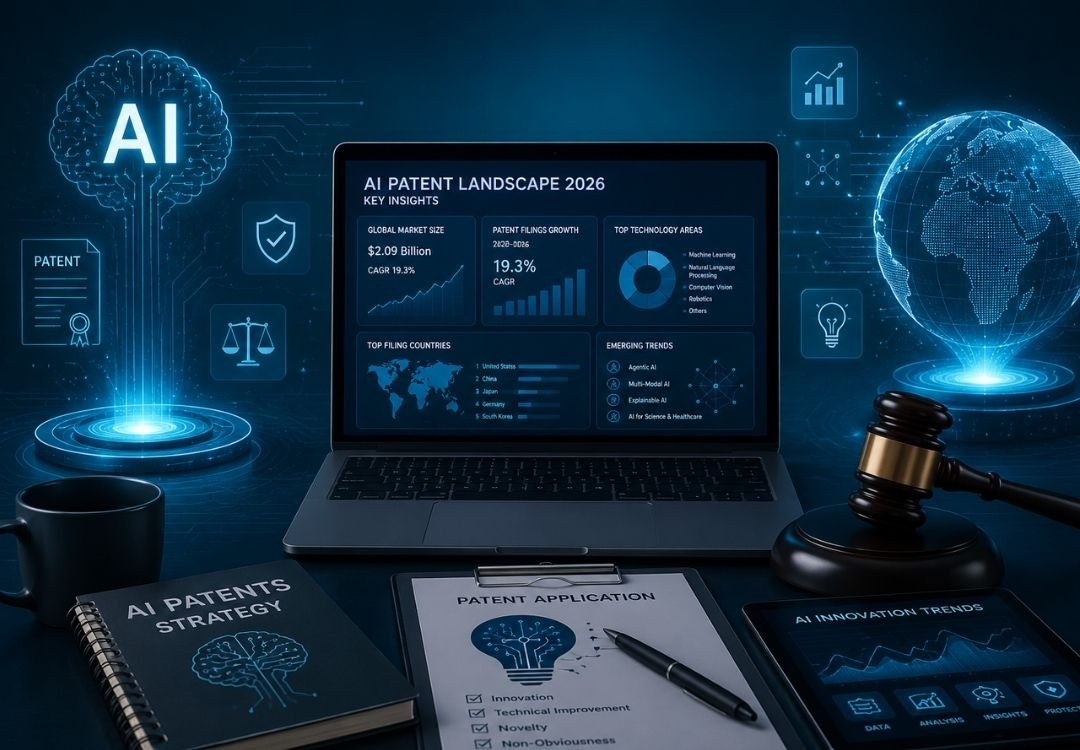
The artificial intelligence (AI) landscape has officially moved past the "hype" phase. As we progress through 2026, we are witnessing a structural transformation in how intellectual property is created, protected, and leveraged. For technology-driven firms like Einfolge Technologies, the narrative has shifted from simple filing volume to high-stakes, sector-specific quality.
If you are an innovator, an IP counsel, or a strategic leader, here is the data-driven reality of the AI patent world today.
1. The Numbers: A $2 Billion Global Race
The AI patent search and intelligence market is no longer a niche service. In 2026, this sector alone is projected to reach $2.09 billion, growing at a staggering CAGR of 19.3%.
While the U.S. and China maintain their lead, the "geography of innovation" is diffusing. According to the WIPO 2026 World Intellectual Property Report, digital tools like generative AI are reaching global markets within days of release. This rapid diffusion has forced a record surge in filings, particularly in the Asia-Pacific region, which is now the fastest-growing hub for patent analytics.
2. The USPTO's "Golden Age" for Software
Perhaps the most significant development for 2026 is the USPTO’s radical shift in eligibility. Under new leadership, the office has moved away from the era of "abstract idea" rejections.
The Kim Memo & SMED: Recent guidelines like the Subject Matter Eligibility Declaration (SMED) framework have made it significantly easier to overcome Section 101 rejections.
The "Technical Delta": Examiners are now directed to focus on whether the AI provides a "technical improvement" rather than dismissing it as a mere business method.
Analyst Insight: 2026 is the most favorable year for U.S. software patents in over a decade. If your AI handles complex calculations that "cannot practically be performed in the human mind," your path to a grant is clearer than ever.
3. From "Generic AI" to "Vertical Intelligence"
In 2026, patenting a "neural network" is like patenting "a wheel", it’s too late and too broad. The value has migrated to Vertical AI models deeply integrated into specific industrial workflows.
|
Sector |
Patent Growth Driver in 2026 |
|
Life Sciences |
AI-driven drug discovery and diagnostic imaging (over 250+ recent FDA-cleared AI devices). |
|
Fintech |
Real-time fraud detection and high-frequency trading algorithms. |
|
Agentic AI |
Systems that move beyond prediction to autonomous execution in supply chains. |
|
Clean Tech |
AI for optimizing hydrogen fuel cells and solar grid management. |
4. The Rise of "Agentic" and "Multi-Modal" IP
The "GenAI wrappers" of 2024 have matured. Today’s high-value portfolios focus on the following:
Multi-Modal Signal Fusion: Patents that cover AI systems capable of simultaneously analysing text, video, and sensory diagrams.
Explainable AI (XAI): As global regulations (like the "Brussels Effect" reaching California) demand transparency, the method of explanation has become a primary patentable asset.
Autonomous Agent Workflows: Patenting the "agentic" loop, where an AI perceives a problem, plans a solution, and executes it without human intervention.
5. Strategic Implications for Einfolge Partners
As a global leader in patent research, Einfolge Technologies sees a clear trend: quality is the new quantity. Corporate IP teams are now using AI to prune "junk" patents and focus on "defensive moats."
Invention Harvesting: AI tools are now used to "mine" R&D notes to find hidden inventions before they leak.
Competitive Intelligence: Patents are being used as "live" strategic assets. Analysing a competitor’s filings in 2026 reveals their R&D direction 18–24 months before a product hits the market.
Human-in-the-Loop: While AI-assisted drafting is now used in almost 80% of firms, the "interpretive layer" deciding which risks are real and which are theoretical remains a strictly human expertise.
The Road Ahead
The AI patent landscape of 2026 is fast, favourable, and fiercely competitive. For firms like Einfolge, the goal isn't just to file; it's to build a "technical record" that can survive the scrutiny of a global, AI-accelerated market.
In this "Golden Age," the question isn't whether your AI is patentable, it's whether your patent is strong enough to define the future of your industry.
"At Einfolge, we combine these 2026 data signals with human expertise to ensure your AI portfolio isn't just large, it's untouchable. Contact our researchers today for a custom landscape analysis."