Patenting AI in 2026: Mastering the "Technical Delta" to Overcome Global Eligibility Rejections
While artificial intelligence development moves at high speed, global intellectual property strategies frequently struggle to keep pace. Tech startups and research labs routinely engineer custom transformer architectures, optimize inference pipelines, and refine neural models, only to encounter statutory subject matter rejections from major patent offices.
The central barrier is Subject Matter Eligibility. Patent authorities worldwide regularly categorize software and machine learning claims as non-patentable mathematical concepts, abstract ideas, or "computer programs per se."
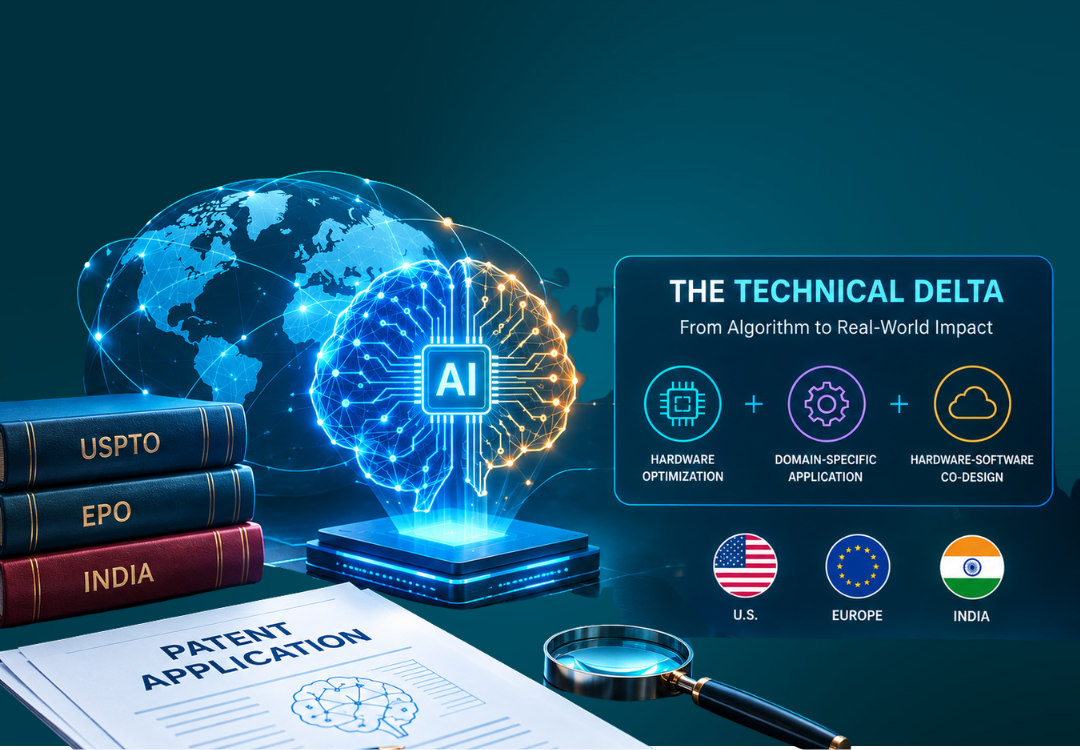
To secure enforceable, high-value IP protection, patent applications must clearly establish the Technical Delta-the concrete, functional, or structural contribution an AI system makes to hardware execution, software operations, or an underlying physical process.
1. Why Machine Learning Models Face Statutory Rejections
Underneath their user interfaces, machine learning models function on calculus, linear algebra, and statistical probability. When a patent specification describes an invention strictly through high-level data handling or generic algorithmic logic, examining authorities apply strict eligibility tests:
Primary Legal Thresholds Across Jurisdictions
United States (35 U.S.C. § 101): Applying the Alice/Mayo framework, claims reciting pure computational operations (such as vector clustering or loss calculation) are classified as abstract concepts or mental processes. To pass Step 2A/2B evaluation, claims must integrate the concept into a practical application or demonstrate a direct technological improvement.
Europe (Articles 52 & 56 EPC): Under the European Patent Office (EPO) COMVIK approach, computational frameworks are treated as abstract mathematical methods by default. Non-technical aspects (such as linguistic parsing or pure data sorting) are ignored during inventive step evaluation unless tied directly to a specific technical effect or practical goal.
India (Section 3(k) Patents Act): The Indian Patent Office expressly excludes "mathematical methods, algorithms, and computer programs per se." Bypassing Section 3(k) requires claims to prove a measurable technical result tied to specialized hardware or an engineering system.
2. Defining the "Technical Delta"
The Technical Delta distinguishes what an algorithm mathematically computes from how it solves a specific computational, hardware, or engineering bottleneck.
To meet global patent standards, an AI invention should demonstrate a Technical Delta across at least one of three operational categories:
Category A: Structural & Architectural Enhancements (The System Delta)
Rather than claiming generic network layers, highlight modifications to the internal architecture that create hardware-level optimizations:
Quantization Strategies: Lowering precision formats to minimize memory bandwidth usage.
Attention & Pruning Shifts: Cutting inference latency on edge processing units.
Custom Backpropagation: Modifying gradient calculations to reduce power draw during model training.
Category B: Domain-Specific Technical Integration (The Applied Delta)
Abstract algorithmic models gain eligibility when tied directly to a concrete physical or technical problem:
Ineligible Claim: "A method for categorizing 3D point cloud data using a convolutional neural network."
Eligible Claim: "A system for real-time LiDAR processing in autonomous vehicles, using a multi-resolution neural network structure to keep frame latency under 5 milliseconds."
Category C: Hardware-Software Co-Design (The Silicon Delta)
Architectures designed around execution hardware are among the most defensible:
Algorithms optimized for specialized hardware like TPUs, ASICs, or neuromorphic processors.
Custom memory mapping that eliminates cache misses during multi-modal inference runs.
3. Four Strategic Rules for Drafting AI Patents
Patent legal teams and technical writers should follow four essential practices when building applications:
1. Establish Clear Cause-and-Effect Relationships
Never document an algorithm in isolation. Detail the complete technical loop:
2. Provide Thorough Reproducibility Details
To avoid sufficiency-of-disclosure or "black box" rejections, include full descriptions of loss functions, hyperparameter configurations, dataset pre-processing pipelines, and complete workflows so a skilled artisan can reproduce the results.
3. Avoid Mental Process Terminology
Phrasing that implies a human could complete the steps mentally or on paper triggers abstract rejections.
Avoid: "Sorting numerical data vectors into clusters based on proximity scores."
Adopt: "Synthesizing audio waveforms from a clustered array of numerical values via dedicated memory buffer operations."
Incorporate Benchmark Evidence Early
Document quantitative performance metrics in the initial specification. Proof demonstrating a 25% drop in memory usage or a 40% gain in signal clarity offers objective evidence of a technical effect when responding to office actions.
4. Cross-Border Requirements at a Glance
|
Factor |
USPTO (United States) |
EPO (Europe) |
IPO (India) |
|
Primary Statute |
35 U.S.C. § 101 (Alice/Mayo) |
Art. 52(2)/(3) EPC (COMVIK) |
Section 3(k), Patents Act 1970 |
|
Core Test |
Integration into practical application (Step 2A/2B) |
Technical character & technical inventive step |
Concrete technical effect & functional contribution |
|
Drafting Focus |
Proving non-abstract operational gains |
|
|
Protect Your AI Innovations with Einfolge
Navigating AI patent eligibility requires deep technical knowledge combined with cross-border legal precision. Missteps in claim drafting can leave core technologies vulnerable or result in costly, drawn-out office actions.
At Einfolge, our team of IP analytics experts, patent agents, and technical specialists help technology companies turn complex AI breakthroughs into robust, enforceable global patent portfolios.
Whether you need prior art searches, Freedom-to-Operate (FTO) analyses, patent drafting, or national phase PCT entries across key global jurisdictions, Einfolge provides the end-to-end support required to safeguard your intellectual assets.
Contact Einfolge today to consult with our IP strategy team and secure your AI pipeline.